What’s the difference between Shifting vs. Sliding?
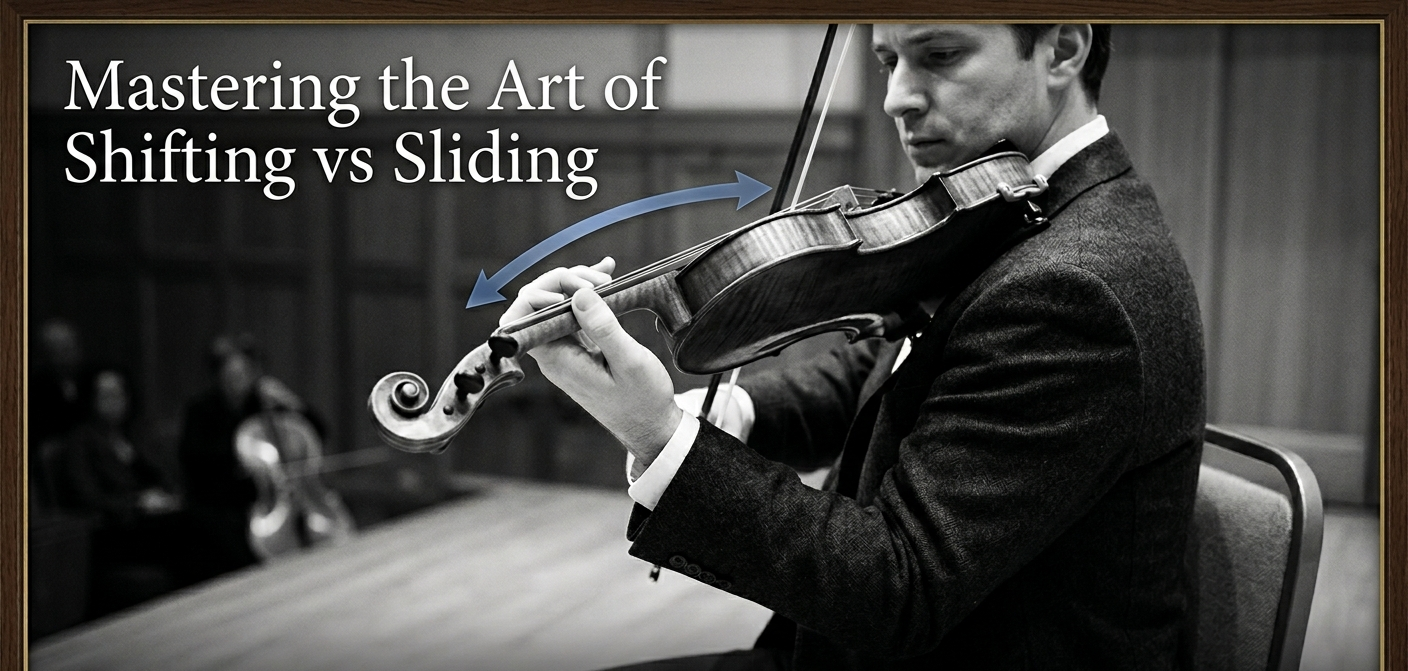
When do you shift or slide?
In the world of professional violin playing, the terms "shifting" and "sliding" are often used interchangeably by students. However, to the trained ear, they represent two completely different intentions. One is a mechanical necessity, and the other is a stylistic ornament.
Understanding when to move invisibly and when to "sing" between the notes is what separates a student-level performance from a professional one.
1. The Shift: The Invisible Transition
A shift is purely functional. Its goal is to move the hand from one position to another without the audience hearing the "journey."
The Mechanism: The finger pressure is released almost entirely, allowing the hand to "skim" the string.
The Aesthetic: Transparency. In the works of Bach, Mozart, or in fast technical etudes, the shift should be silent.
The Goal: To reach the new position with perfect intonation without a "zip" or "ghost note" in between.
2. The Slide: The Expressive Portamento
A slide, or portamento, is a deliberate choice. It mimics the human voice and is used to add emotional weight to a melodic line.
The Mechanism: Unlike the shift, you maintain a specific amount of light contact with the string during the transit. This is where the "French" shifting method is used to its greatest effect, or using the Russian shifting cleverly.
The Aesthetic: Vocal and lush. This is a hallmark of the Romantic era—think of the works of Brahms, Bruch, or Kreisler.
The Goal: To connect two notes emotionally, creating a "sigh" or a "yearning" quality.
Stylistic Awareness
The most common error is the "accidental slide"—sliding in a passage where a clean shift is required. This often happens because of excess tension or a lack of finger-pressure control. As a violinist, your goal is to be in total command of the sound: you should only slide when you mean to.
Developing a "clean" shift is the foundation of technical security, while mastering the slide is the key to musical maturity. By separating these two movements in your practice, you gain the ability to choose the right "color" for every piece of music you play.
The distinction between a functional shift and an artistic slide is a hallmark of professional playing. While understanding the theory is the first step, achieving total control over these movements requires a disciplined ear and consistent practice.
I work with students to refine these subtle transitions and develop the control necessary for high-level performance. To see how we can elevate your technique together, click Learn More below.
