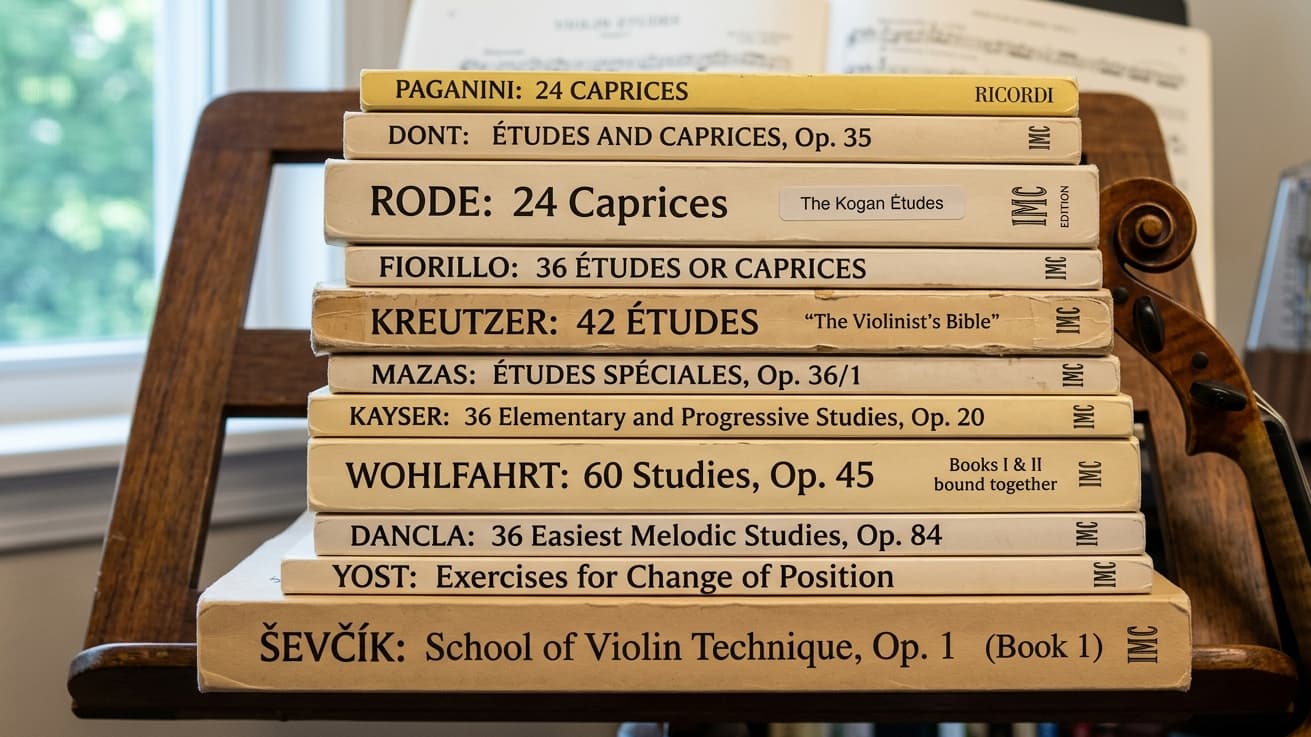
While selecting the right étude and putting in the hard work is the cornerstone of developing reliable and expressive violin technique — hard work is only half the battle. Without a clear roadmap and a skilled teacher to steer the course, you're just practicing in the dark; even the most disciplined practice can lead to a frustrating dead end.
Don’t get me wrong — self-discipline is important, but on an instrument as demanding as the violin, it isn’t enough. You wouldn't build a house without a blueprint, and violin technique is no different. Without an experienced teacher to oversee the foundation, you risk building on shaky ground — investing months, or even years, into a technique you’ll eventually have to tear down and start over.
Mastering the violin requires a roadmap. This curriculum, drawing from the French, German, and Russian traditions, is the same roadmap I followed during my training with 4 distinct teachers. While studying with Dorothy DeLay, I worked simultaneously with two technical assistants on scales and foundations, while a fourth mentor focused exclusively on the artistry of the bow hand. I now offer my students a synthesis of these four perspectives, providing a complete and proven path to virtuosity. Please note that while essential scale systems — such as those by Carl Flesch or Ivan Galamian — are excluded from this list to keep our focus on étude literature, they remain a non-negotiable part of your daily routine. Think of scales as drinking water and études as essential vitamins; you need both to thrive!
I. Foundational
Dancla: 36 Easiest Melodic Studies, Op. 84
The Cantabile: Requires purity, simplicity, and evenness of bow. It challenges the student to maintain an "unspoiled" tone while mastering elementary bowing skills. Great for all students who have already finished Suzuki 1-3 or played violin for at least 1 year.
Ševčík: School of Violin Technique, Op. 1 (Book 1)
The Foundation: This is the bedrock of modern technical development. It focuses on systematic finger independence and precise intonation by breaking down difficulties into microscopic repetitions. I still remember the dreadful first page when I had my first lesson with Ms. DeLay at Juilliard. A must for all students seeking to build a solid foundational technique. Added bonus if you can also work on Henry Schradieck’s Finger Exercises.
Wohlfahrt: 60 Studies, Op. 45
Core Mechanics: Book I solidifies 1st position with détaché and mixed bowings; Book II introduces 3rd position and functional shifting.
Yost: Exercises for Change of Position
The Bridge to Fluidity: Focuses on the "mechanics of the shifting." It teaches students to move between positions without tension, emphasizing the intermediary note and a relaxed thumb. I personally worked through the entire book of these demanding shifting exercises. They were challenging — painful, even — but the reward was a rock-solid technical foundation that has stayed with me ever since. A must for all students seeking to build a solid foundational technique.
Wohlfahrt: 40 Elementary Studies, Op. 54
Bowing Variety: Adds complexity with legato and dotted rhythms, including Mazurka styles.
II. Intermediate
Kayser: 36 Elementary and Progressive Studies, Op. 20
The Germanic Style: A reliable right-hand builder and the initial preparation for the polyphony for the glorious Bach Solo Sonatas and Partitas.
Mazas: Études Spéciales, Op. 36/1
The Lyricist: Stylish and violinistic literature that bridges the gap between technical exercises and musical performance. Great segue into the infamous Kreutzer 42 Études.
Kreutzer: 42 Études
"The Bible" of Violin Playing: A comprehensive set of contrasting techniques combining the French and German schools. This is the mandatory midpoint for every serious student - especially the infamous etude #2. Henryk Wieniawski, the renowned virtuoso — famously highlighted the deceptive difficulty of Rodolphe Kreutzer’s 42 Etudes and Caprices for Violin. He noted that despite their straightforward appearance, they are technically demanding and require immense care to master, a sentiment often echoed by pedagogues regarding the foundational technical challenges they pose to violinists.
Fiorillo: 36 Études or Caprices
Sharpening The Fundamentals: A gateway to the virtuosic demands of Locatelli, Rode, and Paganini—designed to bridge the gap between technical agility and the sophisticated artistry of tone, color, and style. A must for all students seeking to build a solid foundational technique.
III. Advanced
Gaviniès: 24 Matinées
Advanced Mechanics: Covers sophisticated right-hand string crossings and left-hand frame & structures, like sixths and tenths. Start with 8, 12, 17.
Rode: 24 Caprices — The Infamous "Kogan" Études
The Russian Connection: Indispensable for a refined sound and fluid technique. Leonid Kogan famously emphasized that every Russian student was required to study these thoroughly; the Russian school swore by their effectiveness in building a polished, professional technique. Frank-Peter Zimmermann — alongside many of the world’s elite virtuosos —famously refers to these as the “Kogan” études, a testament to the fundamental role these caprices play in mastering violin technique. An essential cornerstone for every serious student committed to advancing their technical mastery. Caprices to focus on: 2, 3, 5, 13, 17, 18
Dont: Études and Caprices, Op. 35
The Peak of the Auer Era: Focuses on position work and finger dexterity. Demanding right-hand chord playing and extreme left-hand extensions/coordination. I personally played about half of these; great supplemental technical exercises to up your game.
IV. Virtuoso Mastery
Wieniawski: 8 Études-Caprices, Op. 18
Technical Growth: Far more than mere technical drills. They serve as a vital bridge between the foundational studies of Kreutzer and the ultimate virtuosic peaks of Paganini. Each caprice is a masterclass in balance, forcing the violinist to maintain impeccable intonation while navigating the intricate bow strokes and rapid-fire shifting that defined the 19th-century Franco-Belgian school. Highly recommend #3 and #4.
Paganini: 24 Caprices
The Final Destination: These are monumental in violin repertoire, and it’s used to test & show off technique, not build it. They should only be approached with a fully polished traditional foundation. Recommend doing all 24 if you’re really serious about the violin, but start with 16, 14, 20, 13 (in this order) to ease into the world of Paganini.
Ernst: 6 Polyphonic Studies
The Ultimate Challenge: This is the grand finale and the hardest — the extreme of violin writing and some of the most technically complex works ever composed for solo violin. This one is totally optional, and I personally have not played all 6 myself. I only played two, which are very famous violin solo repertoire: “The Last Rose of Summer” and “Der Erlkönig” transcription.