Congratulations! You’ve decided to learn the violin. Hopefully, you’ve found a teacher, booked your slot, and marked the calendar.
This is an incredibly exciting time, but if you’re like most adults (or parents of children) starting a new instrument, the excitement is probably mixed with a healthy dose of anxiety.
What if I show up unprepared? What if I bought the wrong thing? What are we actually going to do?
Take a deep breath. Your teacher doesn’t expect you to show up knowing how to play Bach. In the beginning, it is all about the HUG foundations:
Holding the instrument
Understanding how it works, and most importantly…
Getting comfortable (this takes decades/a lifetime to master)
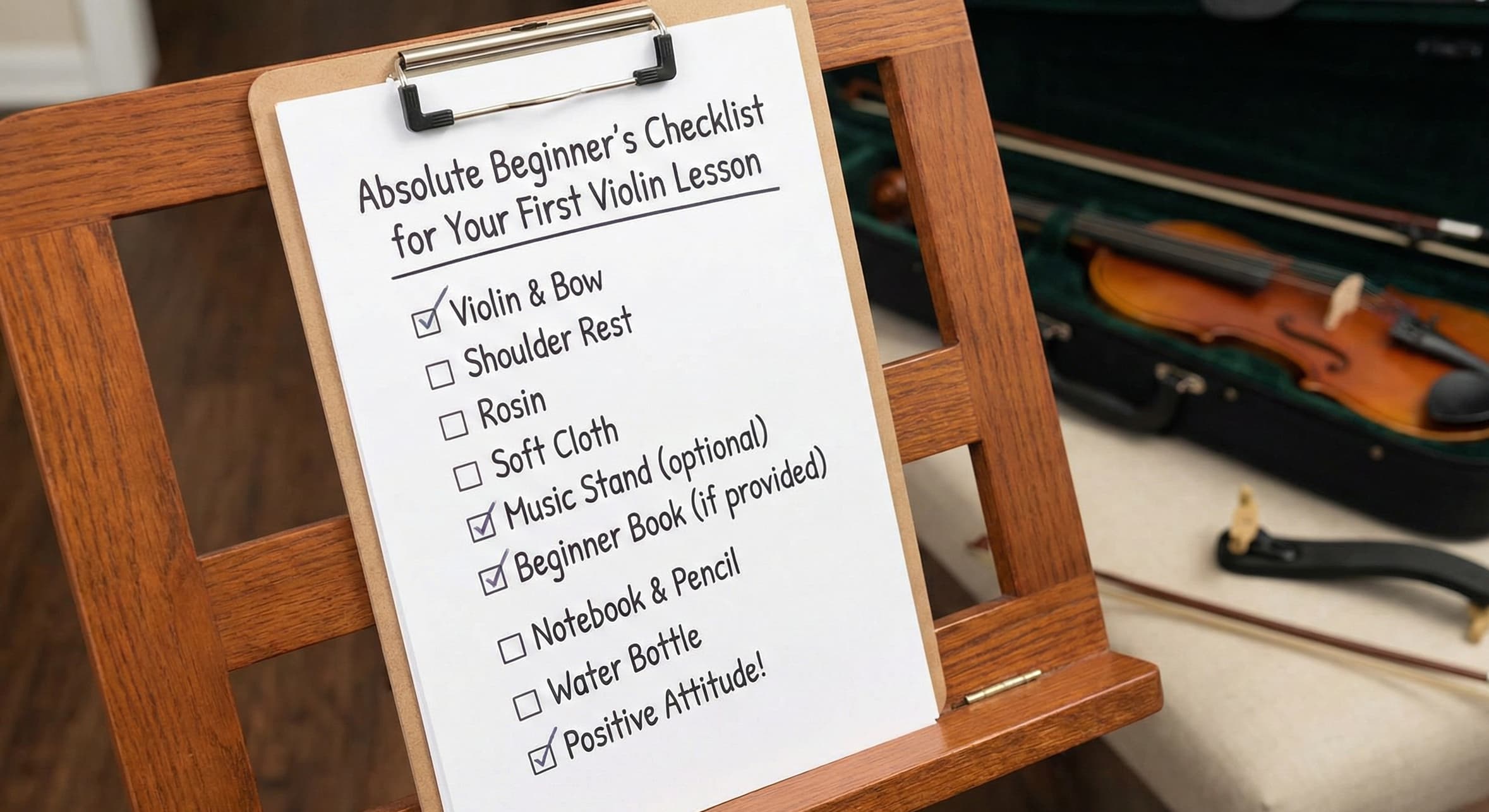
To help calm those pre-lesson jitters, I’ve put together the definitive checklist of what you need for that very first session.
Part 1: The Gear & Essentials
You can't play without the instrument. Most beginners rent their first violin, which is highly recommended as you start out. A standard rental "outfit" usually includes the violin, bow, and case.
[] 1. The Violin Outfit (Sized Correctly) If you are renting, ensure the shop has sized you. Violins come in fractions (1/16, 1/8, 1/4, 1/2, 3/4, 7/8, 4/4 or “Full Size”). An adult will almost always need a 4/4 full size, but children need to be measured to ensure they aren't struggling with an instrument that is too big.
[] 2. The Bow Check inside your case. The bow is usually secured in the lid. Ensure the hair (the white part) isn't frayed or broken.
[] 3. A Shoulder Rest or Sponge —Super Important and also a Lifelong Journey!
It is very difficult to comfortably hold the instrument between your chin and shoulder without any support, especially when you are just starting out. In fact, as your body changes over time, finding your ideal setup is an evolving process that can easily take years—or in my personal case, decades.
A comfortable setup is highly individual. A poorly fitted arrangement—whether it uses a shoulder rest, sponge, or no additional support—can contribute to discomfort and unnecessary tension. The goal is balanced, adaptable movement that suits the player’s anatomy.
One useful experiment, ideally with teacher guidance, is to briefly remove the shoulder support and notice how the violin meets the collarbone. This can help you compare setups; it is not a requirement, and the best arrangement depends on the individual player.
PRO TIP
First & foremost, there is no “right” approach — you can reach the absolute pinnacle of the instrument with or without a shoulder rest. It ultimately comes down to whatever works for you. There are many debates and discussions around this, but I personally believe that not using a shoulder rest is one step closer to being more “free” in violin playing.
Foams & Sponges: PSR and Belvelin foams tend to be popular & comfortable, but there are so many inexpensive choices. I personally use Belvelin Medium.
Shoulder Rests: I’ve spent thousands of dollars using many different shoulder rests (and chin rests) for decades and only recently switched to foams. When using shoulder rests, I personally loved Viva la musica and Kun Bravo shoulder rests. However, I always found shoulder rests to be somewhat rigid and “uncomfortable”, and did not enjoy how inflexible shoulder rests are compared to foams. A shoulder rest can feel restrictive if its height, angle, or placement does not suit the player, while a well-adjusted one can provide comfortable support and freedom of movement.
Best for beginners: The standard plastic Kun shoulder rest is a common, accessible starting point for many beginners. When it fits the player well, it can make holding the violin easier and allow more attention to basic fundamentals.
[] 4. Rosin Rosin is a hard block of tree resin. You rub it on the bow hair to make it sticky; without rosin, the bow will slide silently across the strings. Your rental outfit likely came with a cake of rosin in the accessories pocket.
Part 2: The Learning Tools
[] 5. The Method BookDo not guess on this. Before your first lesson, reach out to your teacher and ask: ”Is there a specific book you’d like me to purchase?” If they don’t have a specific title in mind, hold off on buying anything — many teachers provide their own handouts for the first few sessions. For beginners, I personally recommend the Suzuki Method and for more advanced students seeking an alternative to Suzuki, I strongly suggest the Galamian Method and Carl Flesch Scale System — I have been trained extensively in all of these.
[] 6. A Notebook and Pencil You will think you’ll remember everything the teacher says. You won’t. You need a dedicated notebook to write down your "homework" for the week, specific tips on posture, or terminology you need to learn.
Part 3: The Practicalities (Don't Ignore These!)
These aren't things you buy, but they are crucial for a successful first lesson.
[] 7. SHORT Fingernails on the Left Hand This is the #1 mistake beginners make. If your fingernails extend past the fleshy tip of your finger, you cannot press the string down correctly to make a clear note. Trimming them is a good ritual to develop when learning the violin.
[] 8. Comfortable Clothing Playing the violin is more physical than many people realize. To ensure you can move freely, choose a shirt that allows for a full range of motion in your arms and shoulders. Avoid thick, bulky layers like heavy sweaters, as they can make it difficult to find and maintain the correct posture.
[] 9. A Clean Microfiber Cloth You need a soft, dry cloth to wipe the rosin dust off the body of the violin and bow (and sweat) after you play. Old t-shirt scraps work, but a cheap microfiber cleaning cloth is best. Keep it in your case.
What NOT to Bring (Yet)
Don't overwhelm yourself with gadgets right away. You generally do not need to bring:
A Music Stand: You need one for home practice, but your teacher will have one at the studio.
An Electronic Tuner: Your teacher will tune your violin for you for the first several weeks or months. Learning to tune comes later.
The Most Important Thing to Pack: Patience
Your first lesson is going to feel awkward. Holding a violin alone will feel super unnatural at first. Your arm might get tired. You might only make squeaky sounds for many months.
That is completely normal.
Your goal for lesson one isn't to make beautiful music; your goal is to understand how to hold the instrument safely and set yourself up for success in lesson two. It is a marathon, not a sprint.
Pack your checklist, trim your nails, and go have fun! :)