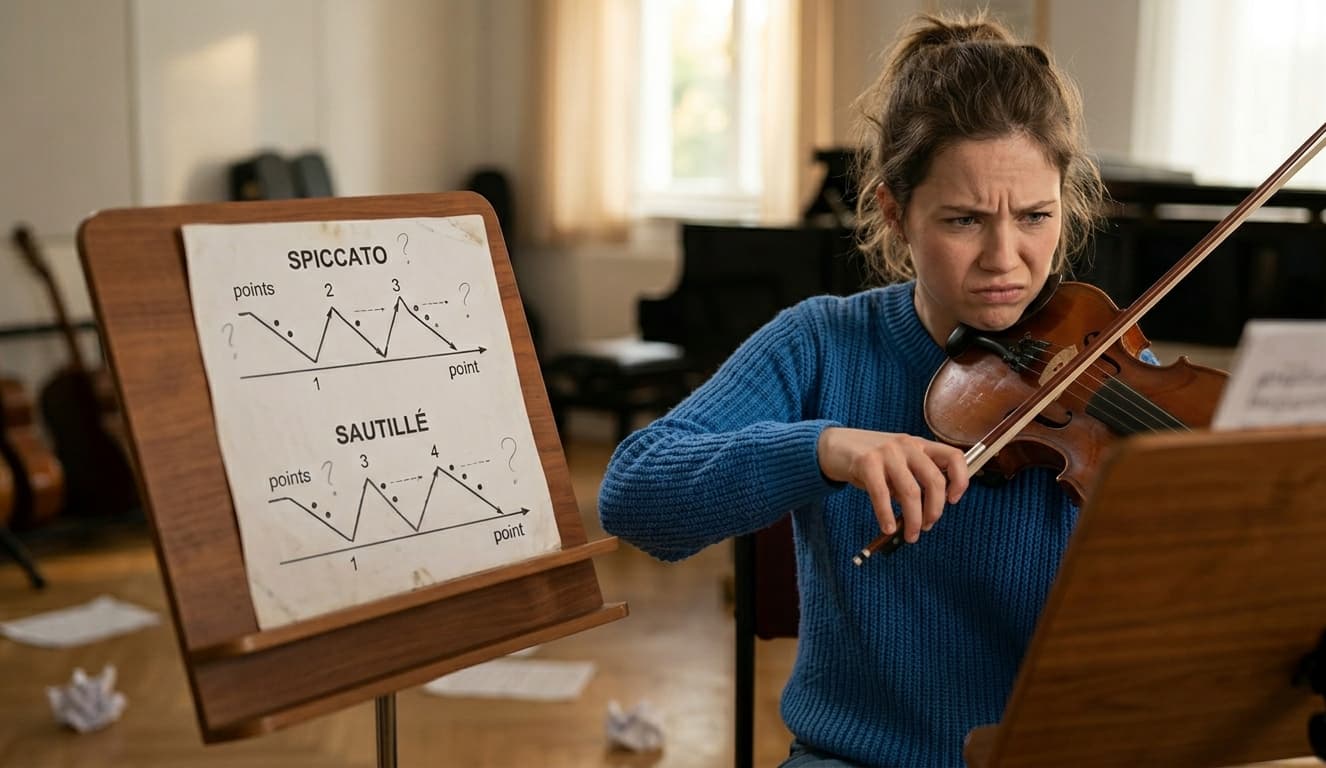
When you see dots over notes in a score, your brain immediately thinks "short." But as your technique advances, "short" isn't enough. You have to decide: do you need the controlled spiccato, the effortless sautillé, or the crisp on-string staccato?
1. Spiccato: The Controlled Drop
Spiccato is a deliberate off-the-string stroke. You are in the driver's seat for every single note.
The Mechanic: A "U" or "V" shaped motion where the bow drops onto the string and is immediately lifted off by the hand. Must utilize your natural arm weight, but do not flop your wrist.
The Feel: Active. Although you’re relaxed, you are physically lifting and dropping the bow, usually at a slow to moderate tempo.
Key Tip: Find the balance point (usually about 1/3 up from the frog) to let gravity do half the work. Most importantly, you have to BREATHE.
2. Sautillé: The Natural Spring
Often confused with fast spiccato, sautillé is actually a different beast. It is a passive stroke.
The Mechanic: At a high speed, the natural elasticity of the wood takes over. You perform a very small detaché (on the string), and the bow starts to jump on its own.
The Feel: Effortless. If you try to "lift" the bow in sautillé, you’ll actually slow yourself down.
Key Tip: Keep the hand extremely relaxed. The bow "wants" to bounce; you just have to let it.
3. Staccato: The On-String Bite
Unlike the first two, traditional staccato is an on-the-string stroke.
The Mechanic: The hair never leaves the string. Each note begins with a "crunch" or a bite (index finger pressure) followed by a quick release.
The Feel: Sharp and percussive.
Key Tip: Think of it like a series of tiny, aggressive stops rather than a bounce.
If the bounce still feels stuck or uneven, return to the fundamentals: bow speed, contact point, balance point, and unnecessary tension. Adjust one variable at a time and listen for how the response changes.