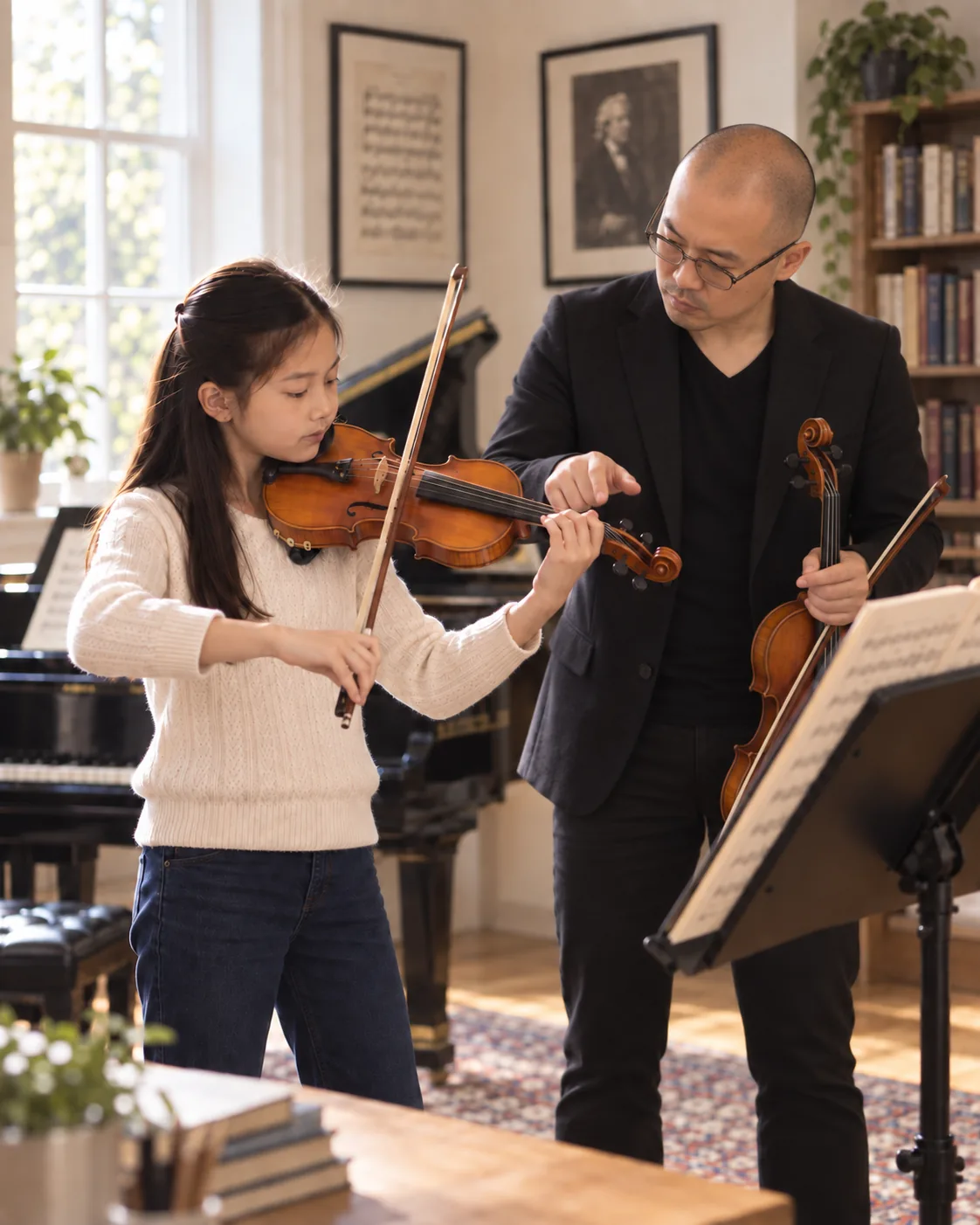
AMEB violin exams give a student a defined goal, but the first preparation task is administrative rather than musical: identify the exact exam. “AMEB violin” can mean a Comprehensive exam or a Repertoire exam, and those formats assess different things. An online violin teacher can help you prepare the playing, hear your practice recordings, and check how your performance holds together from beginning to end. The teacher and family in Australia still need to confirm the current syllabus and arrange the exam through the relevant AMEB state or territory office.
This guide is for students who can already play a few notes on the violin and read basic music notation. It is also useful for parents helping an existing young violinist prepare. BK Violin Studios does not currently teach complete beginners.
First, choose the exam you are actually preparing for
The AMEB NSW violin subject page lists both Comprehensive and Repertoire exams. Its grade descriptions show why the distinction matters: Comprehensive exams may include technical work, pieces, aural tests, sight reading, and general knowledge; Repertoire exams centre on a program of pieces. The precise requirements change by grade, so do not copy a checklist from another student or an old blog post.
Write down the subject, exam type, grade, and examining state or territory. Then check the current violin syllabus, the grade page, and the local office’s enrolment guidance. AMEB NSW’s pre-enrolment checklist specifically asks candidates to confirm the right exam and the correct number of pieces before enrolling. This is especially important if you are moving from a previous grade or changing from Comprehensive to Repertoire.
You also need the current source for the music. Use the current AMEB manual or syllabus for the year you enter; confirm that each selected piece, edition, technical requirement, and any own-choice option is permitted for your exam. Do not assume a book or repertoire list used in an earlier year still applies.
Build a preparation map, not just a piece list
Once the requirements are confirmed, make one page with four columns: component, current state, next task, and evidence. “Evidence” might be a clean recording of a passage at a chosen tempo, a marked score, or a complete run without a restart. That makes online feedback concrete and keeps the exam from becoming an endless series of play-throughs.
For repertoire, mark the passages where tuning, rhythm, bow distribution, shifting, or articulation are unreliable. Start with the smallest musical unit that exposes the problem. Play it slowly enough to hear the cause, then reconnect it to the phrase. Alternate that close work with full runs so the piece retains its shape. A recording is useful here because it captures what happened rather than what you remember happening.
For a Comprehensive exam, give technical work, aural work, sight reading, and general knowledge their own places in the weekly plan if your grade requires them. A scale practised after all the pieces “if there is time” tends to remain fragile. Short, regular checks are easier to sustain: play a technical pattern from memory, read unfamiliar music without stopping, describe a feature of a score, or answer an aural prompt. The AMEB NSW grade descriptions show that these components vary across grades. Your current syllabus is the final authority for what you must prepare.
For a Repertoire exam, do not assume that fewer exam components mean less preparation. The student must carry a complete musical program: starts, endings, character changes, accompaniment, and the transition between pieces. AMEB NSW notes that Repertoire Preliminary, for example, assesses a four-piece program without separate technical, aural, sight-reading, or general-knowledge tests. That is an example of one grade, not a universal piece count.
What online lessons can usefully cover
A clear camera view and sound let a teacher examine the relationship between the left hand, bow, posture, and resulting tone. For lesson feedback, place the camera far enough away to show the whole bow and both hands; record a short sample from the player’s normal position before changing equipment. If a passage sounds distorted, try a second recording with the device farther from the instrument. This is a teaching setup, not an AMEB recording specification.
Send a marked score or name exact bar numbers before the lesson. A useful online session might compare two takes of one phrase, isolate a bow change or shift, and finish with a new recording of the whole passage. Between lessons, keep recordings short and label them by piece, bars, and date. That makes progress easier to hear and avoids spending the lesson locating files.
Online coaching also works well for mock exams. Put the pieces in the planned order, begin each one without a long reset, and continue after a small mistake. For Comprehensive candidates, include the supporting components that apply to the grade. Listen afterward for the first point where concentration, sound, or pace changed. The goal of the mock is to find the next practice priority, not to predict a mark.
Plan accompaniment and the exam format early
Violin preparation has a coordination task beyond the solo part: accompanied works need an accompanist. The AMEB NSW violin page says candidates arrange their own accompaniment for exams. Check the current syllabus and your exam office’s rules for each selected work, then schedule rehearsals while there is still time to adjust tempo, cues, and balance. An online teacher can discuss those decisions, but the player and accompanist need to hear the music together in person where the chosen exam format requires it.
Online lessons are separate from the exam delivery method. Some AMEB offices offer video Repertoire exams, but availability and rules vary. For example, AMEB NSW’s video exam recording guide covers supervision and camera orientation, while its upload guidance says recordings go through AMEB Connect. Those are NSW instructions; candidates elsewhere should use their own office’s current rules. Do not assume that a video option exists for a Comprehensive exam or for every grade.
If you are entering a face-to-face exam, use the official notice to check the venue and time. If entering a permitted video exam, read the current recording and submission rules before the recording day. In either case, leave the final week for complete runs, accompanist coordination, and practical checks rather than changing fingering or repertoire at the last minute.
A simple weekly rhythm
Try a weekly plan with one technical focus, one repertoire focus, and one complete run. For example, the technical focus might be a controlled shift into a difficult passage. The repertoire focus might be a phrase whose bow use runs out before its musical peak. The complete run tests whether those improvements survive when you keep playing. Adjust the balance to the exam format and the time remaining.
At the end of the week, write three short notes: what became more dependable, what still changes between attempts, and the first question to bring to the next lesson. This record is more useful than counting hours alone. It also helps an online teacher respond to the playing you are actually doing at home.
If you are preparing for an AMEB violin exam in Australia, keep your grade, exam type, selected pieces, and approximate exam window together with the current syllabus. Confirm all formal requirements with AMEB before enrolling.