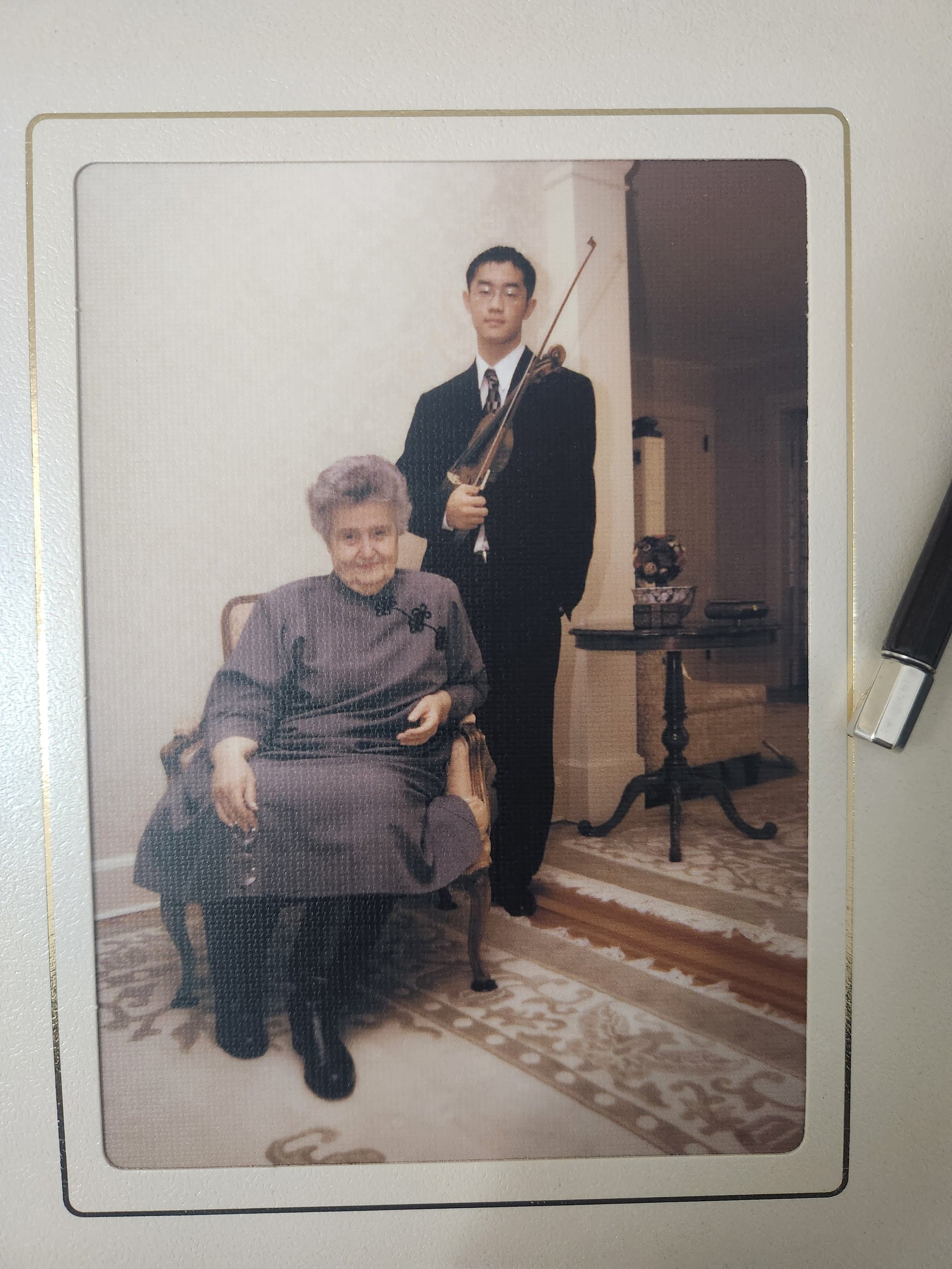
Juilliard describes its Pre-College as “a program for students of elementary through high school age who exhibit the talent, potential, and accomplishment to pursue a career in music.” It runs on Saturdays from September through May. Admission is by competitive audition, and Juilliard states plainly that the division does not accept beginners. For violinists there are two rounds: a prescreening video submitted with the application, then a live audition in New York for the applicants who pass.
I began studying at Juilliard Pre-College at the age of nine, with Dorothy DeLay. This guide sets out what Juilliard currently publishes for violin applicants, what each requirement is really asking for, and how to plan the months before the deadline. Requirements can change from year to year, so check every detail against the official violin requirements page before you apply.
The application timeline
These are the dates on Juilliard’s Pre-College violin page as of October 2026. The page does not print a year beside them, so confirm them when the application opens.
- November 1: the online Pre-College application opens.
- March 1: deadline for the application, the prescreening video and the $75 nonrefundable application fee. Fee waivers are considered after a complete application is submitted.
- March 24, 6 p.m.: prescreening results.
- April 15, 6 p.m.: individual audition schedules released. A list of piano accompanists comes with the schedule.
- May 1: financial aid application due, and the English test due for international applicants.
- May 19: in-person auditions in New York.
- June 10: audition results posted.
Round one: the prescreening video
To qualify for a live audition, a violinist submits the application, a current résumé and a prescreening video of two contrasting works that fit the repertoire requirements for the student’s age group. Two movements of a concerto are acceptable. Everything is played from memory, with piano accompaniment where the music calls for it.
Juilliard’s recording rules are practical rather than technical:
- Upload each movement or excerpt as a separate file, put your best work first, and label each file with the composer and work or movement.
- Any setting is acceptable, from a practice room to a concert hall, but the camera must show you and your instrument fully.
- Recordings must be your own unedited performance, with no added effects such as reverb.
- Check the whole recording for distortion or buzz, and make sure an accompanist does not cover the violin.
- Upload well before the deadline. Files can be as large as 5 GB, and some .mov files use a codec the application does not accept, so converting them to another format first is safer.
“Contrasting” is the word to think about. Two fast movements, or two pieces in the same style, show the panel the same skills twice. A slow concerto movement with a fast one, or a Bach movement with a Romantic piece, shows sound, phrasing and command of the instrument in one submission. Choose the two works you can play most reliably, not the two hardest, because the recording is all the panel will hear in this round.
Plan more than one recording session. The first session usually reveals problems with balance, framing or nerves that are easy to fix the second time. Leave enough time to record again rather than submitting a take you are unhappy with.
Round two: the live audition repertoire
Applicants who pass prescreening audition in person, from memory and with piano accompaniment. Juilliard sets the repertoire by age group:
Students through age 11
- Major and minor scales and arpeggios in three octaves.
- An étude on the level of Mazas, Kayser or Dont (Op. 37).
- A slow and a fast movement of a concerto by a composer such as de Bériot, Viotti, Rode, Bach or Mozart.
- A work that contrasts with the concerto.
Students ages 12 through 14
- Major and minor scales and arpeggios in three octaves.
- An étude on the level of Dont (Op. 37), Kreutzer, Fiorillo or Rode.
- A slow and a fast movement from a concerto by a composer such as Kabalevsky, Mozart, Bruch, Wieniawski or Lalo.
- A work that contrasts with the concerto, or a movement of unaccompanied Bach.
Students ages 15 and older
- Major and minor scales and arpeggios in three octaves.
- An étude on the level of Rode, Dont (Op. 35), Paganini or Wieniawski.
- A slow and a fast movement from a substantial Romantic or contemporary concerto.
- One movement of unaccompanied Bach.
You submit your proposed audition repertoire with the application for review and approval, and you can update it later through your application status page. Juilliard asks applicants to consult their private teacher about suitability first, and provides a form for repertoire questions. Where a requirement names a complete work, all of its movements must be prepared. If a student’s birthday falls close to the boundary between two age groups, ask the admissions office which list applies.
What each requirement is really asking
Scales and arpeggios
The requirement names no particular keys, so prepare every major and minor scale and arpeggio in three octaves. Scales are where a panel hears intonation, the evenness of shifts and the quality of the sound most directly, with nothing to hide behind. Plan the bow distribution so the top octave does not run out of bow, keep one fingering per scale, and make them part of daily practice rather than something reviewed in the final weeks.
The étude
“On the level of” gives you a range, not a target to exceed. A Kreutzer étude played in tune, at tempo and with a clear character tells the panel more than a harder study that only holds together on a good day. Choose the étude that shows the technique you control best, and play it as music, with phrasing and dynamics, not only as an exercise. If you are deciding where a student sits, an étude roadmap can help place the options.
The concerto movements
The slow movement shows tone, phrasing and the ability to sustain a line. The fast movement shows command: rhythm, clarity and stability at tempo. The slow movement deserves as much preparation as the fast one. A clear, projecting tone is rarely an accident, and a slow tempo exposes every uneven bow change.
Unaccompanied Bach
For students 12 and older, Bach appears as an option or a requirement. Unaccompanied Bach shows intonation in chords and double stops, the ability to make separate voices audible, and a sense of pulse with no accompaniment to lean on. Choose a movement whose character you can make clear, and practise it slowly enough to hear every chord in tune.
The contrasting work
For younger students, the contrasting work is a chance to show something the concerto does not: a different character, period or technique. Choose it to complete the picture of the player, not to repeat the concerto’s strengths.
Audition panels often stop a performer before the end of a piece. That is normal, and it is not a verdict. Practise starting each work cold and at different points, so an interruption or a new starting place does not unsettle you.
Choosing teacher preferences
Pre-College students receive 15 one-hour lessons per semester with a studio teacher, so the application asks for teacher preferences. Juilliard says the preferences are confidential and do not affect admission decisions. The faculty are told only after the committee decides. Your audition is scheduled around the availability of your first-choice teacher where possible.
Research the violin faculty before the deadline: read their biographies, listen to their recordings and ask your current teacher for advice. Juilliard notes that you may contact faculty about an optional meeting or lesson, although not every teacher is available, and any lesson fee is the family’s responsibility.
Families applying from outside New York
Out-of-town and international applicants must come to New York for the live audition. Students who move to the New York area to attend must live with a parent or guardian, and Pre-College does not provide academic schooling: every student must also enroll in a full-time academic school.
International families have extra steps with earlier deadlines:
- International students need an I-20 from a private academic school before Pre-College begins in September. Juilliard strongly advises applying to academic schools by December 1, before the Pre-College deadline.
- Non-U.S. citizens whose second language is English take the Duolingo English Test, with a minimum score of 100. For violinists the results are due by May 1. Students who have studied in the United States for a year or more may submit a school transcript and a letter from their ESL teacher or school instead.
- Applicants who need a B-2 visitor’s visa for the audition can ask the Pre-College administration for a letter of invitation.
A preparation plan to March 1
Counting back from the March 1 deadline gives roughly four and a half months from mid-October. Adjust the plan to the student’s starting point.
October to November: choose and memorize
- With your teacher, choose the full live audition repertoire for the student’s age group, including the two prescreening works.
- Memorize everything early. Memory that is still new when the pressure arrives is the first thing to fail.
- Start the application when it opens on November 1. International families should already be working on academic school applications for December 1.
December to January: make it performance-ready
- Book an accompanist and rehearse together well before recording.
- Make trial recordings of the prescreening works and watch them back for framing, sound and balance.
- Perform the prescreening works for an audience at least twice.
February: record and submit
- Record the final takes early in the month, leaving time for a second session.
- Upload, label and order the files, then submit well before March 1.
March to May: the live audition
Keep the full live repertoire moving while you wait for results on March 24, so the scales, étude and Bach are ready if the invitation comes. After the schedule and accompanist list arrive on April 15, arrange a rehearsal with the accompanist and plan the trip to New York.
Lessons for Pre-College preparation
The lessons that matter most here are the ones that find what is unreliable while there is still time to fix it: a shift that works only on good days, a memory slip in the same bar, a slow movement that loses its line. My own study at Pre-College shaped the way I teach, and the lesson checklist Dorothy DeLay used with me still guides how I organize that work. BK Violin Studios teaches online worldwide and in person in Bergen County, New Jersey, close to New York. No teacher can promise an admission result. The realistic goal is a student who is fully prepared, plays from secure memory and has practised performing under pressure.