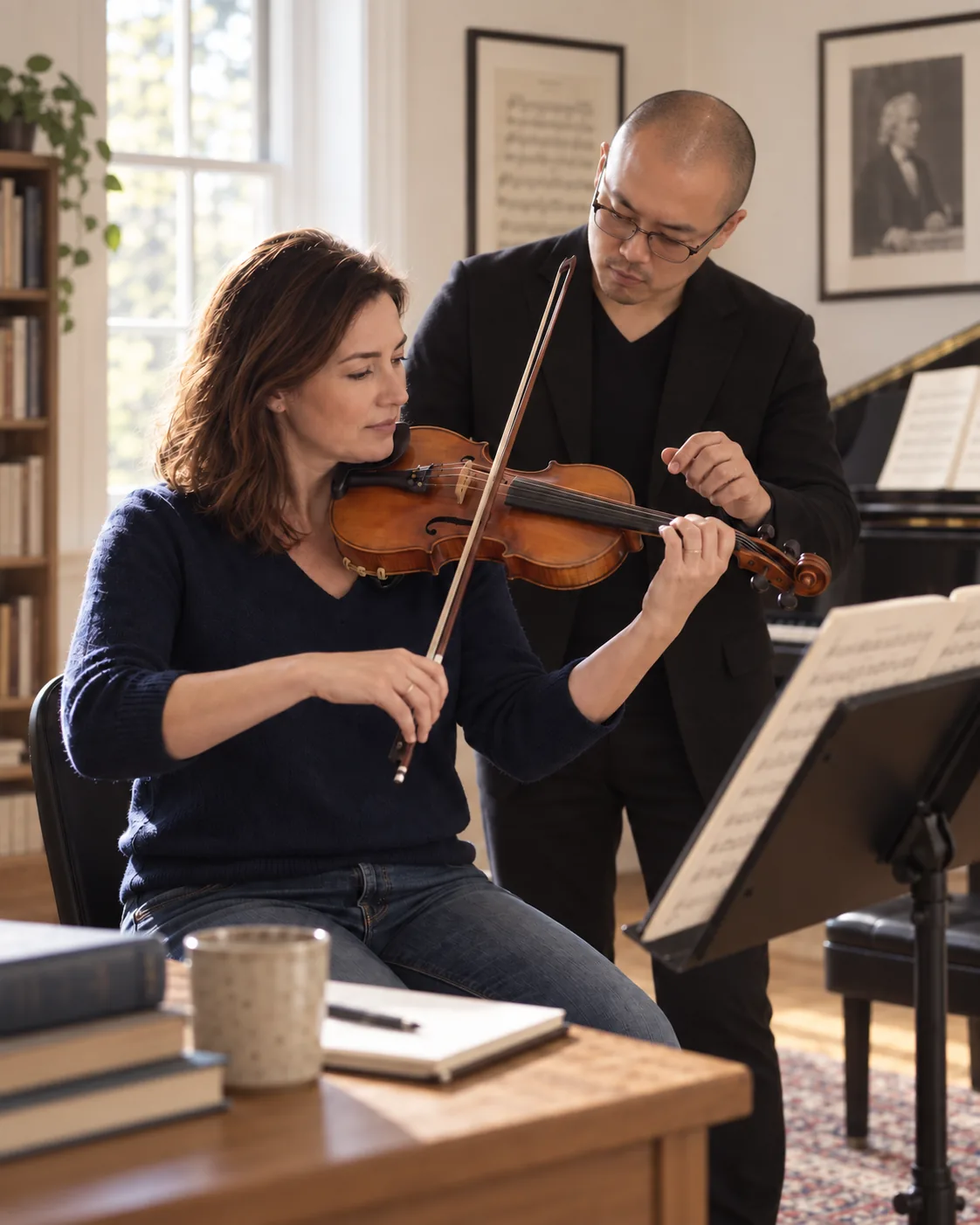
The violin may have been in its case for five years, twenty years, or just a busy season. You might remember the shape of a scale but find that the bow no longer feels quite predictable. Or perhaps you are an adult at an early stage: you can already play a few notes and read basic music notation, and you want a clearer way to continue.
Both starting points belong here. This guide is for adults with some playing foundation, including returners and newer players who can play a few notes and read basic notation. It is not a guide for someone who has never played violin or learned to read music. The first 90 days below are a way to organize your attention, not a deadline for reaching a particular level.
Before you practise: make the instrument usable
An old violin deserves a quick check before you judge your playing. Look for an open seam, a leaning bridge, a loose chin rest, or strings that are difficult to tune or stay in tune. If anything seems unstable, ask a qualified violin shop or luthier to examine it. A bow with worn hair may also make sound production harder to assess. You do not need a perfect instrument to resume, but avoid building your first weeks around a preventable setup problem.
Put the music stand at a height that lets you read without folding over the instrument. Set aside a place where you can make sound without watching the clock every minute. These small choices make it easier to notice what your hands are doing.
Weeks 1–2: take inventory without rushing
Begin with material you can already recognize. Play a few open strings, a simple scale or pattern, and a short piece well below the hardest music you once played. Record a minute of playing on your phone if you are comfortable doing so. The recording is a reference point, not a verdict.
Listen and feel for three things:
- Sound: Can you draw an even sound on an open string at a comfortable bow speed?
- Coordination: Do the fingers and bow arrive together in a slow passage?
- Comfort: Do your neck, shoulders, thumb, or wrist begin to work harder as you continue?
If reading feels slower than you remember, spend a few minutes each day naming notes and rhythms away from the violin, then play a short passage slowly enough to read it rather than rely on memory. Returners sometimes remember finger patterns faster than they can read; keeping both skills active matters.
At this stage, resist testing yourself with your old showpiece. It may tell you that you are rusty, but not what to practise next. A short, familiar exercise reveals far more about bow path, timing, intonation, and tension.
Weeks 3–6: rebuild one dependable motion at a time
Choose one bowing focus and one left-hand focus for a week. For example, keep the bow moving parallel to the bridge on open strings, then pair that with a slow one-octave scale. Another week might focus on clean string crossings and fingers landing without squeezing. Name the change you are listening for before each repetition.
Short sessions can be useful if they are specific. A 20-minute practice might include five minutes of open strings, five minutes of a scale, and ten minutes on four measures of a piece. On a longer day, add reading and repertoire rather than repeating the same exercise until attention fades. Leave a note about the next starting point before closing the case.
If a passage becomes less reliable after several attempts, make it smaller. Play two beats, then one measure. Try the rhythm without the bow or the bowing on an open string. Slow the passage enough to hear whether the trouble comes from the left hand, bow, reading, or the coordination between them. This is more informative than repeatedly playing from the beginning.
Pay attention to physical discomfort. Ordinary effort and unfamiliarity can accompany a return to practice; pain is a reason to stop and seek appropriate advice. A teacher can help identify a setup or movement question in the playing, but persistent pain warrants assessment by a healthcare professional.
Weeks 7–12: connect the work to music
By now you may have a better sense of which motions are returning easily and which need careful work. Choose a piece you enjoy that allows you to play some phrases with attention to sound and shape. A second, easier piece can be useful for reading. The goal is to bring the scale and bow work into actual music, not to keep technique isolated indefinitely.
Mark one or two spots where a technical choice affects the phrase. A long note might need steadier bow speed; a string crossing might need a different bow level before the change; a difficult rhythm might need counting aloud before it feels natural. Practise the technical move separately, then return to the surrounding phrase and listen for whether the music flows more clearly.
Progress does not always sound dramatic from one day to the next. Compare a short recording from this week with the one you made earlier, if you made one. Look for a steadier sound, a more reliable entrance, or less effort in a passage. Those observations give you a more useful next step than a general impression that you are either “back” or “behind.”
A weekly practice plan for a busy adult
The best routine is one you can repeat. Three or four focused sessions may suit your week better than an ambitious daily plan you cannot maintain. A simple rhythm could look like this:
- Session A: open strings, one scale, and a short technical passage.
- Session B: reading, rhythm, and the easiest section of your piece.
- Session C: review the technical passage, then connect it to a musical phrase.
- Optional session: play through familiar music for enjoyment and note one question for next week.
You can shorten each session without discarding its purpose. On a ten-minute day, choose one open-string observation and one small passage. If you miss a week, resume with the last manageable task. You do not need to “make up” every lost minute.
When a lesson may help
A lesson can help when you cannot tell why a passage is unreliable, when an old habit returns, or when you want to choose music that fits your current playing. For a returner, the useful first question is often not “What level was I?” but “What can I do comfortably now, and what do I want to play next?” Newer adults who can play a few notes and read basic notation can ask the same question.
An online lesson can address many of these questions if the teacher can see both hands and the bow and hear the instrument clearly. Bring a short passage, a specific question, and an honest description of your available practice time. That gives the conversation a practical starting point, whether your goal is renewed enjoyment, steadier technique, or preparation for more demanding repertoire.
The first 90 days do not need to recreate the player you used to be—or prove that you are advancing quickly enough. Use them to learn what works now. A playable instrument, manageable material, attentive practice, and a reason to keep making music are a strong basis for whatever comes next.