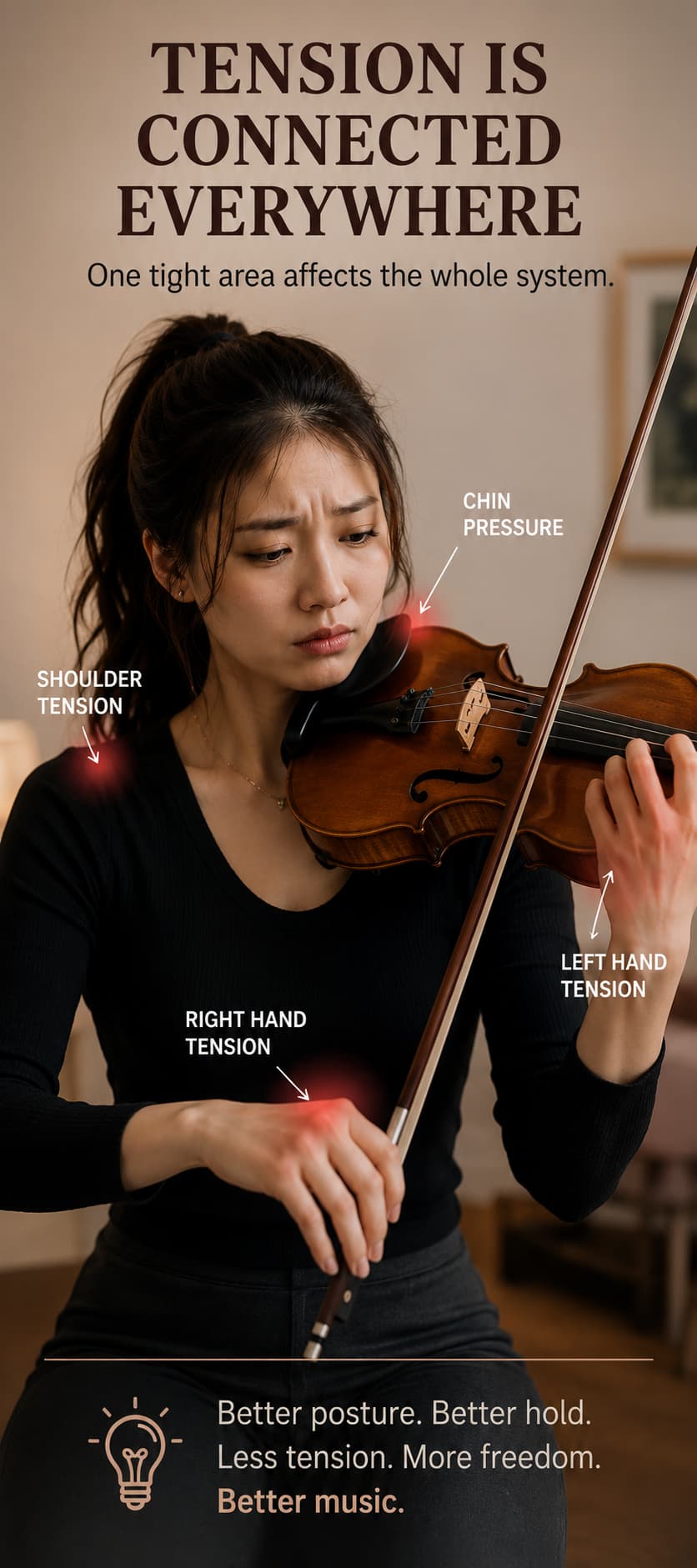
One of the most common questions I hear from violin students is:
"How do I relax my hand?"
Most students immediately assume the problem is in the fingers, thumb, or wrist. They search for finger exercises, stretching routines, or vibrato drills.
But in many cases, the real problem begins before the left hand even touches the fingerboard.
Freeing the Left Hand
The left hand has one primary job: to move freely.
It needs to shift smoothly, vibrate naturally, and place fingers with precision. These movements become more difficult when the hand has to grip or carry excessive weight from the instrument.
When the violin is not balanced comfortably among the collarbone, shoulder, jaw, and the natural weight of the head, the left hand may begin to compensate. The thumb squeezes harder, the wrist becomes rigid, and the fingers lose their freedom…and your right hand also becomes tense making scratchy sounds.
Many students don't even realize they're doing this because it gradually becomes their "normal."
Everything in the Body Is Connected
One of the biggest misconceptions in violin playing is that the left hand and right hand work independently.
They don't.
The body functions as one connected system.
If your shoulders become tense while trying to hold the violin, that tension doesn't stop there. It travels through the neck, into the arms, and eventually reaches both hands.
The left hand begins gripping.
The right arm becomes heavier and less flexible.
The bow no longer feels effortless.
Students often complain,
"My bow feels tight today."
"My left hand won't relax."
In reality, both hands are simply responding to the same underlying tension elsewhere in the body.
A Better Violin Hold Creates Better Technique
Finding the right balance doesn't mean clamping the violin harder between your chin and shoulder.
It also doesn't mean lifting your shoulder to "grab" the instrument.
Instead, the goal is a natural, balanced setup where the violin feels supported without unnecessary muscular effort.
When this foundation improves, something interesting happens:
The left thumb softens naturally.
Shifting becomes smoother.
Vibrato becomes easier.
Finger action becomes lighter.
The bow arm feels freer.
Tone production improves because the right arm is no longer fighting unnecessary tension.
Instead of fixing ten different technical problems individually, you've removed one of the biggest causes behind all of them.
Technique Is About Removing Obstacles
Many students believe improvement comes from adding more exercises.
Sometimes it does.
But often, improvement comes from removing what shouldn't be there.
Excess tension is one of the biggest obstacles to beautiful violin playing.
Once your body learns to support the violin efficiently, both hands are finally free to do what they were designed to do: make music.
That is why in my teaching, I don't simply correct fingers or bow strokes in isolation. I look at the entire setup—posture, balance, violin hold, and body alignment—because solving the root cause almost always leads to better technique, a more beautiful sound, and a much more enjoyable playing experience.