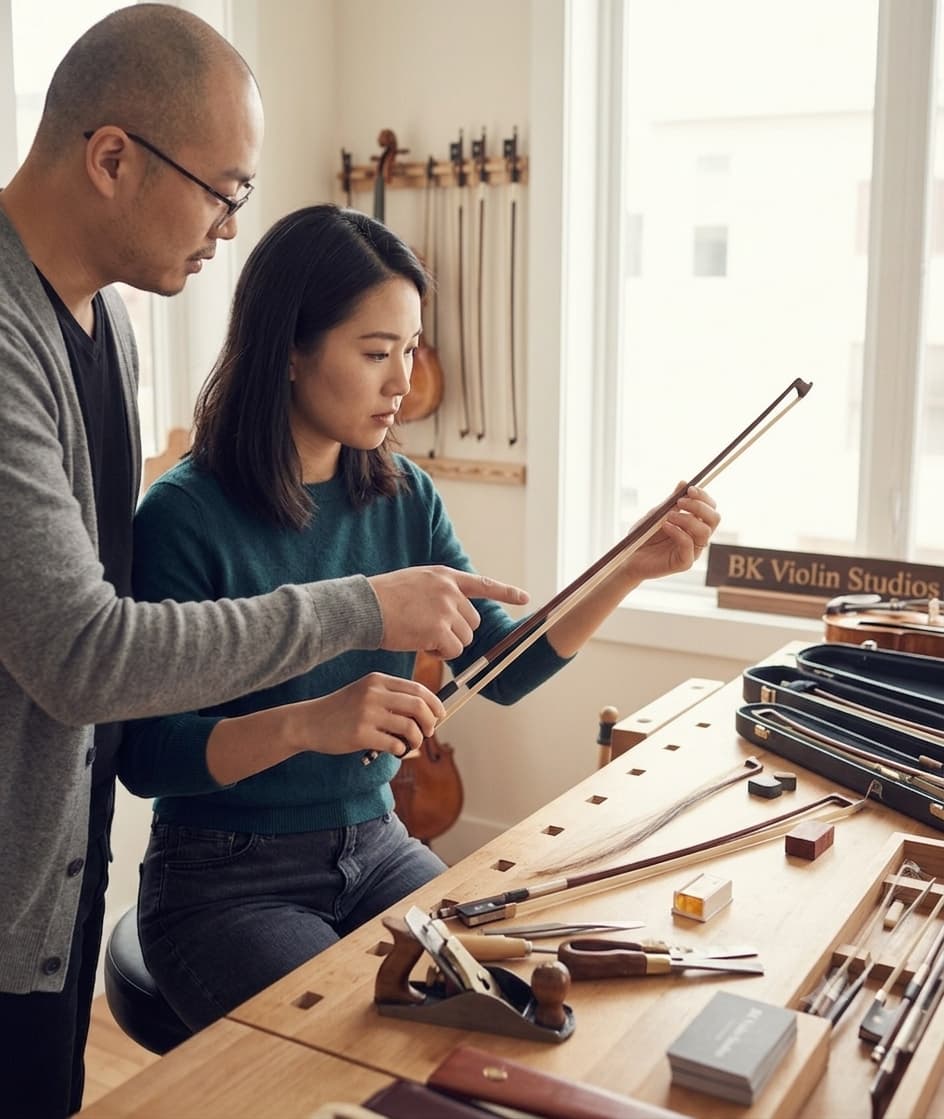
Today after work, I spent some time helping a violist search for a fine bow. A fantastic French bow, C. Thomassin, to be specific.
At first glance, buying a bow seems simple. You try a few, pick the one you like, and you're done.
The reality is very different — and selecting the right bow proves far more challenging than choosing a violin or viola.
Most violin shops will hand you ten, twenty, or even thirty bows to compare. After the first few, they begin to sound surprisingly similar. A bow that initially feels incredible may lose its appeal after twenty minutes. Another may reveal strengths that weren't obvious at first.
The biggest challenge isn't finding a good bow.
It's knowing how to compare them objectively.
Many musicians end up asking themselves:
"I think I like this one... but why?"
Or worse,
"Is it actually better, or is it just different?"
That's where today's consultation began.
My client today was in a slightly different situation. She had already found a viola bow she was seriously considering, but she wasn't completely convinced it was the right choice. Rather than making a decision after trying just one bow, she wanted to compare it against other strong candidates before committing. So instead of starting from scratch, we used that bow as our benchmark. Every candidate bow had to answer one simple question:
Does this bow genuinely outperform the one you already own—or, in this case, the one you're considering?
But answering that question requires more than simply playing a few favorite passages.
For every bow we tested, we evaluated the same characteristics:
Tone quality and richness of overtones
Projection
Response
Legato
Articulation
Spiccato
Stability
Dynamic range
Comfort
Pairing with your instrument
Instead of relying on first impressions, I scored each category and discussed what we were hearing and feeling. Some bows projected beautifully but lacked warmth. Others produced a gorgeous sound but responded too slowly with sluggish spiccato (it was really hard to let this one go - it was a fine W. E. Hill bow). A couple felt comfortable in the hand but didn't give enough stability under pressure.
By breaking each bow down into these individual qualities, patterns started to emerge. The decision became much clearer—not because one bow had the biggest name or the highest price tag, but because it consistently performed better across the areas that mattered most for her playing. I intentionally had my client not look at the bow and switched the order of bows to make sure she wasn’t making colored assumptions.
By the end of the afternoon, we found a bow that was a genuine step up from the one she had originally planned to purchase—and remarkably, it was in the same price range.
That, to me, is the value of an instrument consultation.
It isn't about convincing someone to buy the most expensive equipment in the room.
It's about replacing uncertainty with a structured process, so when you invest in a fine bow, you know exactly why you've chosen it.
Because the best bow isn't necessarily the rarest or the most expensive.
It's the one that helps you make music more effortlessly, with greater enjoyment, while bringing out the very best in your instrument.